
Most ecommerce stores losing ground in organic search aren’t losing because of backlinks. They’re losing on the page itself.
On-page SEO for ecommerce covers every element you control directly on product pages, category pages, and landing pages — from title tags and heading structure to structured data, internal links, and body content.
Get these right, and organic search becomes your highest-converting acquisition channel. Get them wrong, and even a strong backlink profile won’t save you.
This guide covers every on-page ranking factor that moves the needle for ecommerce: what each one does, how to implement it correctly, and how to measure whether it’s working.
What Is On-Page SEO for Ecommerce?
On-page SEO for ecommerce is the practice of optimizing individual product pages, category pages, and landing pages so search engines can understand and rank them for transactional queries.
It covers every element you control directly on the page: title tags, meta descriptions, heading hierarchy, body content, internal links, image attributes, and structured data markup.
This is separate from ecommerce technical SEO (crawlability, server behavior, site architecture) and off-page signals like backlinks or brand mentions. On-page work happens at the individual URL level.
Ecommerce on-page SEO differs from standard content SEO in 4 specific ways:
- Page volume: A store with 10,000 SKUs has 10,000 product pages to optimize, each competing for transactional queries
- Thin content risk: Product pages with only a title and price give Google almost nothing to index beyond the manufacturer’s copy
- Duplicate content from faceted navigation: Filter combinations (color + size + price) generate near-identical URLs that split ranking signals
- Commercial intent alignment: Every page element must match what a buyer expects to see, not just what ranks
Organic search drives 43% of all ecommerce traffic, making it the largest single acquisition channel (Reboot Online, 2025). On-page optimization is the primary lever for capturing that traffic at the page level.
What On-Page Ranking Factors Matter Most for Ecommerce Pages?
On-page ranking factors for ecommerce fall into two groups: signals Google reads directly from the page, and signals it infers from how users interact with that page.
Retailers that optimize title tags and product descriptions see a 32% increase in organic sales (BigCommerce internal data). That number makes title and content optimization the highest-return on-page activity available.
| On-page factor | Page type | Primary signal |
|---|---|---|
| Title tag | Product Category | Keyword relevance + CTR |
| H1 heading | Product Category | Primary topic declaration |
| Body content | Product Category | Depth, uniqueness, intent match |
| Structured data | Product | Rich result eligibility, entity clarity |
| Internal links | Category → Product | PageRank distribution, crawlability |
| Image alt text | Product | Contextual relevance, image search |
Search intent alignment sits above all of these. A product page with a perfectly optimized title tag but the wrong intent match (informational when users want transactional) will not rank for its target query.
70% of ecommerce searches are transactional (Taylor Scher SEO). Product pages must match that intent explicitly, not approximate it.
How Keyword Intent Shapes On-Page Decisions
Transactional keywords signal buying readiness. Queries with “buy,” “price,” “discount,” or “free shipping” show 1.8x higher CTR and 2.4x better conversion rates than generic terms (Ranktracker, 2024).
Product pages should target these directly. Category pages capture navigational and broader commercial intent, where the buyer is still evaluating options rather than ready to purchase.
The Role of Unique Content per Page
96.55% of all indexed pages receive no organic traffic from Google (Ahrefs). A primary reason: content duplication. Pages that reuse manufacturer descriptions compete against dozens of other stores with the exact same text.
Rewriting product descriptions with unique specifications, use cases, and context gives Google a reason to rank your version above the rest.
How Do Title Tags and Meta Descriptions Affect Ecommerce Rankings?
Title tags are a direct on-page ranking signal. Meta descriptions are not. But both affect whether someone clicks your result, and CTR feeds back into how Google ranks pages over time.
Google’s internal system (Navboost) tracks how users interact with search results. Pages that earn more clicks than their position predicts get a ranking boost (confirmed during the 2023 Google antitrust trial by VP of Search Pandu Nayak).
Product Page Title Tag Formulas
The highest-performing pattern for product pages:
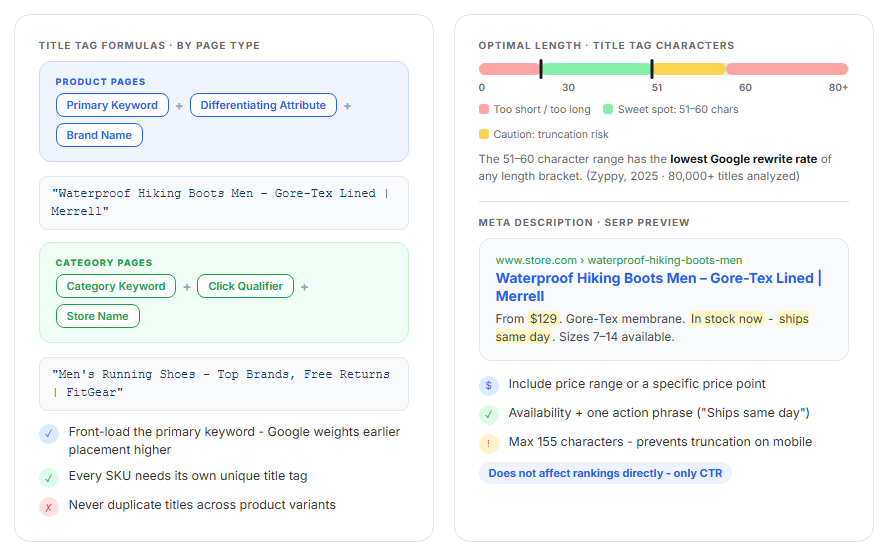
[Primary Keyword] + [Differentiating Attribute] + [Brand Name]
Example: “Waterproof Hiking Boots Men – Gore-Tex Lined | Merrell”
- Front-load the primary keyword (Google weights earlier placement slightly higher)
- Add an attribute that captures long-tail variants: color, material, size set, use case
- Keep the full title between 51 and 60 characters (Zyppy, 2025 study: this range has the lowest rewrite rate)
- Avoid duplicating the title across variants — each SKU needs a unique tag
Well-optimized title tags lift CTR by 20–40% compared to generic alternatives (EcomSEO Academy).
Category Page Title Tag Formulas
Category page pattern:
[Category Keyword] + [Qualifier] + [Store Name]
Example: “Men’s Running Shoes – Top Brands, Free Returns | FitGear”
The qualifier adds a click incentive without sacrificing the head keyword placement. Avoid including specific product names here — category titles should capture broad navigational queries, not product-level searches.
Meta Description Click-Through Optimization
Meta descriptions do not affect rankings directly. Google confirmed this repeatedly. Their value is entirely in CTR.
For product pages, include: price range or a specific price, key attribute, availability, and one action phrase (“Ships same day,” “In stock now”). Keep it under 155 characters to avoid truncation on mobile.
The first organic result gets an average CTR of roughly 22% (Semrush, 2023 State of Search). Position 2 gets around 10%. A meta description that converts position 3 clicks at the rate of position 1 is worth more than a ranking bump.
How Should Ecommerce Product Pages Use Headings and Body Content?
Heading structure tells Google which query the page answers and at what level of specificity. Body content gives Google the context to confirm that answer is accurate and complete.
One H1 per page. It must match the primary transactional query. “Men’s Waterproof Hiking Boots” on the H1 with “Outdoor Trail Footwear” in the title tag creates a mismatch that dilutes the page’s topical signal.
H2 and H3 Usage on Product Pages
H2s work well for: feature breakdowns, material specifications, sizing guides, compatibility lists, and care instructions.
H3s work well for: sub-attributes within a feature section (e.g., “Waterproofing” under an H2 about materials, with H3s covering “Gore-Tex,” “PU Coating,” and “Seam Sealing”).
This hierarchy reduces the cost of extraction for Google’s NLP systems. Each heading declares a specific subtopic. Each section body answers it directly.
How Much Body Content Do Product Pages Need?
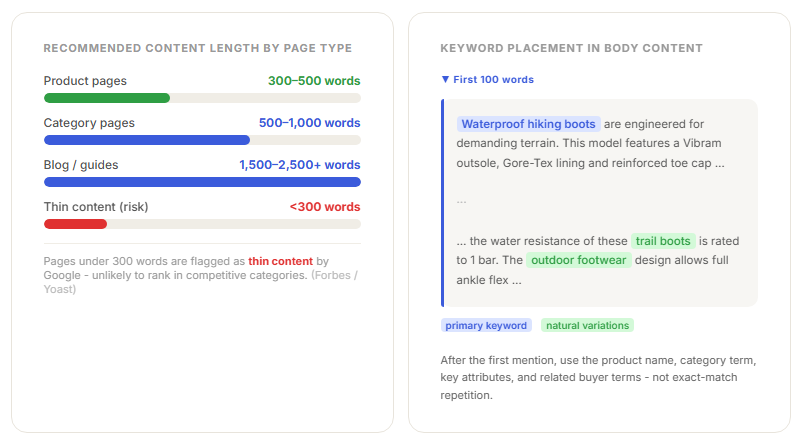
Product pages with 300+ words of unique body content outperform thin pages by a measurable margin in competitive categories (Semrush, 2023). But word count is not the target. Complete EAV (entity-attribute-value) coverage is.
A product page for a standing desk should cover: dimensions, weight capacity, motor type, noise level, warranty, compatible accessories, and typical buyer use cases. If those attributes are present and written uniquely, the page will usually hit 300+ words naturally.
Walmart and Target rewrite manufacturer specs into structured, buyer-focused descriptions on category-level product pages. The result: their pages rank for transactional long-tail queries that manufacturer-copy pages cannot touch.
Keyword Placement in Body Content
Place the primary keyword within the first 100 words of body content. This is not about keyword density. It is about confirming to Google’s crawler, early in the document, that the page matches the declared title and heading.
After that, use natural variations: the product name, category term, key attributes, and related terms that buyers actually use. Repeating the exact match keyword every 100 words reads as stuffed and dilutes readability.
What Is the Role of Structured Data in Ecommerce On-Page SEO?
Structured data markup communicates product information to Google in a machine-readable format. In return, Google can display that information as rich results: star ratings, price, availability, and shipping details directly in the SERP.
Pages with structured data earn a 35% higher CTR from rich results compared to standard blue-link listings (Clickforest, 2025). For ecommerce schema markup, that lift applies most directly to product pages competing in commercial queries.
| Schema type | Where to use | Rich result unlocked |
|---|---|---|
Product | Every product page | Price Availability Rating stars |
AggregateRating | Product pages with reviews | Star ratings in SERP snippet |
BreadcrumbList | All pages | Category path in URL display |
FAQPage | Category + buying guide pages | Expandable Q&A in SERP |
Product Schema Required vs. Recommended Properties
Google requires name, image, and at least one of: offers, review, or aggregateRating for a product page to be eligible for rich results. For Shopping results specifically, price, priceCurrency, and availability within the Offer type are also needed.
Recommended additions that increase rich result quality:
- sku — product identifier
- brand — the manufacturer entity
- description — written product summary
- gtin — barcode identifier for merchant listings
Partial implementation produces zero rich result lift. A Product schema missing AggregateRating will not show star ratings, regardless of how many reviews the page contains.
BreadcrumbList Schema for Category Pages
BreadcrumbList schema replaces the raw URL in the SERP snippet with a readable path: Home › Shoes › Men’s › Running. This communicates site hierarchy to both users and Google.
72.6% of pages on Google’s first page use schema (Backlinko). Only 30% of websites overall have implemented it (Searchmetrics). That gap is an opportunity.
Implement BreadcrumbList on every page with the canonical category path. For products that belong to multiple collections (common in Shopify), the breadcrumb should always reflect the primary canonical category, not a secondary one.
Use JSON-LD format. Google recommends it over Microdata and RDFa because it stays cleanly separated from the HTML structure. Validate every implementation with Google’s Rich Results Test before indexing.
How Does Internal Linking on Ecommerce Sites Impact Page Rankings?
Internal links distribute PageRank. Every link from one page to another passes a portion of that page’s authority to the destination. On an ecommerce site with thousands of URLs, how that authority flows determines which pages can rank competitively.
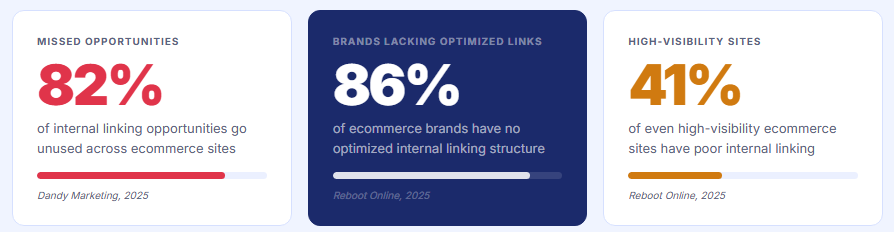
Up to 82% of internal linking opportunities are missed across ecommerce sites, and improving internal link structure can deliver a 30% increase in crawl rates for large sites (Dandy Marketing, 2025).
Category-to-Product Linking Structure
Standard silo architecture for ecommerce:
Home → Category → Subcategory → Product
Each level links down to the next. Category pages accumulate the most external backlinks and hold the highest authority on most ecommerce sites. Linking from category pages to high-priority product pages channels that authority directly to conversion-focused URLs.
A case study with a large retail ecommerce brand showed a 24% increase in organic traffic to level two and three category pages after adding more contextual internal links from top-level pages (seoClarity, 2024).
Anchor Text and Orphaned Pages
Descriptive anchors outperform generic “click here” or “view product” text for SEO signal strength. Google uses anchor text to understand the topic of the destination page. Ten pages linking to your running shoes category with the anchor “men’s running shoes” gives Google a strong relevance signal for that URL.
Orphaned product pages — pages with zero internal links — are crawled less frequently. John Mueller (Google Search Advocate) has confirmed that pages not linked from anywhere on the site receive significantly less crawl attention and are unlikely to rank. Use Screaming Frog or Ahrefs’ Site Audit to find and fix them during any ecommerce SEO audit.
86% of ecommerce brands lack optimized internal links (Reboot Online, 2025). Even 41% of high-visibility ecommerce sites have poor internal linking structures. This is one of the most consistent and fixable on-page gaps across the industry.
How Do Images Affect On-Page SEO for Ecommerce?
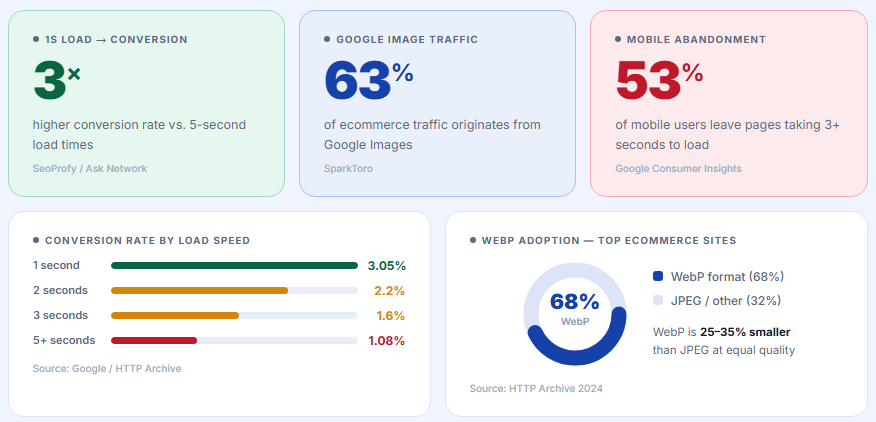
Product images are both an on-page ranking factor and a separate traffic source through Google Image Search. They also directly influence Core Web Vitals — specifically LCP (Largest Contentful Paint), which is frequently triggered by the hero product image on a product page.
Ecommerce sites loading in 1 second have 3x higher conversion rates than slower stores (SeoProfy). A large unoptimized product image is one of the fastest ways to fail that threshold.
Alt Text, File Names, and Format
Alt text rules: descriptive, keyword-relevant, under 125 characters. “navy-blue-slim-fit-chino-pants-levis” outperforms “product-image-3” for both accessibility and image search ranking.
File name before upload: Rename files before they go into your CMS. “nike-air-max-270-black-mens-size-10.jpg” gives Google a relevance signal before the crawler even reads the alt attribute.
68% of top ecommerce sites use WebP format (HTTP Archive, 2024). WebP files are typically 25–35% smaller than JPEG at equivalent visual quality. Smaller file sizes directly reduce LCP time on product pages where the main image is above the fold.
Images and Core Web Vitals
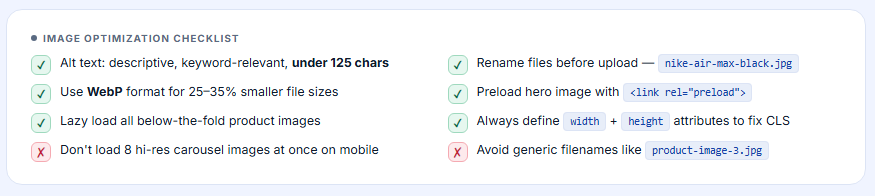
53% of mobile users abandon pages that take longer than 3 seconds to load (Google Consumer Insights). On mobile, product image carousels that load 8 high-resolution images at once are a common cause.
2 fixes that directly lower LCP on product pages:
- Preload the hero product image with
<link rel="preload">so the browser fetches it before layout paint - Lazy load all below-the-fold images so only the visible product image blocks initial render
Cumulative Layout Shift (CLS) on product pages is usually caused by images loading without defined width and height attributes. Set explicit dimensions on every <img> tag. The browser reserves the right space in the layout before the image loads, preventing the page from jumping as elements shift in.
What Is Faceted Navigation and How Does It Create On-Page SEO Problems?
Faceted navigation is the filter system on ecommerce category pages that lets users narrow results by attributes like size, color, price, and brand.
The SEO problem: every filter combination creates a unique URL with near-identical content. A single category page for “running shoes” can generate thousands of parameterized URLs, each competing against the same parent page for the same queries.
53% of ecommerce sites have missing or incorrectly implemented canonical tags, affecting an average of 40.38% of pages on those sites (Reboot Online, 2025). Faceted navigation is the primary cause.
The 3 core SEO issues faceted navigation creates:
- Duplicate content across filtered URLs that share the same product grid
- Crawl budget waste as Googlebot spends time on low-value filter combinations
- PageRank dilution when internal links point to dozens of filtered variants instead of the canonical category
When to Canonicalize Faceted URLs
Default rule: canonical tags on all filtered URLs point back to the parent category page.
Example: /shoes?color=blue&size=10 carries a canonical pointing to /shoes. This consolidates ranking signals and link equity to the page you actually want to rank.
Canonical tags are treated by Google as a strong hint, not a directive. For faster removal of over-indexed filter pages, combine canonicals with a noindex tag on specific high-volume problem URLs. (Note: Google may ignore a canonical when noindex is present, so choose one signal per URL deliberately.)
When to Index Faceted Filter Pages
Index a faceted URL only when 2 conditions are met: there is measurable search demand for that specific filter combination, and the resulting page contains enough unique content to satisfy that query on its own.
Zalando’s approach: the brand indexes color-based facet pages (e.g., “grey t-shirts”) as standalone category URLs with self-referencing canonicals and proper hreflang implementation. Each indexed facet has a unique title tag, H1, and 150+ words of original copy. The result: those pages rank for long-tail commercial queries that a blanket canonical strategy would surrender entirely.
For all other facet combinations, disallow crawling via robots.txt or exclude from sitemaps. Never link internally to filter URLs that are canonicalized away. Internal links to canonicalized pages still distribute PageRank away from the preferred URL.
How Do Category Pages Rank for Competitive Ecommerce Keywords?

Well-optimized category pages typically generate 3–5x more organic revenue than individual product pages because they rank for high-volume head terms and capture buyers earlier in the research phase (Digital Applied, 2026).
Most stores serve category pages with nothing but a product grid and a generic H1. That is the gap.
H1, Title Tag, and Above-the-Fold Content
The H1 must match the primary head-term query exactly. “Women’s Running Shoes” on a category page targeting “women’s running shoes” is correct. “Athletic Footwear for Her” is not.
Content placement: place a concise 50–100 word introduction above the product grid and a longer 200–300 word editorial section below it. Testing by major retailers consistently shows users prefer to see products first. Both blocks satisfy the SEO requirement for unique body content and the UX requirement for immediate product visibility.
Internal Links and Subcategory Structure
Category pages should link explicitly to their subcategories in the body content, not just in the navigation menu. Body content links pass more PageRank than navigational links.
Flat architecture rule: every important category and subcategory page should be reachable within 3 clicks from the homepage. Pages buried at 4+ clicks receive significantly less crawl attention and PageRank (Shopify internal guide, 2025). For stores with 200+ products, create subcollections rather than deep pagination.
User-Generated Content on Category Pages
73% of the largest ecommerce brands actively use user-generated content (UGC) across their site pages (Reboot Online, 2024). Only 28% of mid-sized brands do the same.
Review counts and aggregate ratings on category pages send freshness and trust signals to Google. They also give the page unique content that updates without editorial effort.
98% of the lowest-performing ecommerce sites lack any UGC (Reboot Online, 2024). This is one of the clearest patterns separating high-ranking category pages from those that stall on page two.
How Does Page Experience Influence On-Page SEO for Ecommerce?
Google’s Page Experience update (2021) made Core Web Vitals a confirmed ranking signal. The 3 metrics that matter: LCP (Largest Contentful Paint), INP (Interaction to Next Paint, replacing FID in March 2024), and CLS (Cumulative Layout Shift).
Sites loading in 1 second convert at 3.05%, while 4-second sites convert at just 0.67%. That is a 4.5x difference in conversion rate from 3 extra seconds of load time (SeoProfy, 2024).
| Core Web Vital | What it measures | Google’s “Good” threshold |
|---|---|---|
LCP | Time for main content to load | Under 2.5s |
INP | Response time to user input | Under 200ms |
CLS | Visual stability during load | Score under 0.1 |
Ecommerce-Specific CWV Problems
LCP on product pages is almost always triggered by the hero product image. An unoptimized hero image over 200KB commonly pushes LCP past 3 seconds on mobile.
Preloading the hero image with <link rel="preload" as="image"> is the single fastest LCP fix available on most ecommerce product pages. It signals the browser to fetch the image before layout paint begins.
INP and CLS on Ecommerce Pages
INP delays on ecommerce sites typically come from 2 sources: JavaScript-heavy filter panels that block the main thread during user interaction, and third-party scripts (chat widgets, analytics tags) that execute on page load.
CLS is caused by images loading without defined dimensions and by lazy-loaded content above the fold. Set explicit width and height on every product image tag. Reserve space in the layout before the image loads. This eliminates the most common cause of layout shift on product and category pages.
Google Search Console’s Core Web Vitals report segments pages by “Poor,” “Needs Improvement,” and “Good” status, pulling from real Chrome user data via the Chrome UX Report. This is the correct starting point for any ecommerce product page performance audit. PageSpeed Insights gives field data per URL. Use both.
How Do You Optimize Product Pages for Keyword Intent in Ecommerce?

Long-tail keywords convert at 2.5x the rate of broader head terms (Taylor Scher SEO, cited in Charle Agency, 2025). They account for 65% of all ecommerce search queries. Product pages are the primary destination for that traffic.
Intent matching is what separates product pages that rank from those that stagnate. A product page optimized for a transactional query but written for an informational one will not hold position one for long.
Transactional vs. Informational Intent on Product Pages
Transactional signals in search queries: “buy,” “price,” “discount,” “in stock,” “free shipping,” and specific model numbers.
Informational signals: “how to choose,” “review,” “vs,” “best for.” These do not belong in the H1 of a product page. They belong in supporting content within H2 or H3 sections below the fold, where buyers who are still evaluating can find spec comparisons, FAQs, and use-case guidance without interrupting the purchase flow.
Buyers research before they buy. A product page covering both dimensions — transactional above the fold and informational below — captures users at both stages of the decision cycle.
Long-Tail Keyword Targeting for Product Variants
Product variants (color, size, material, bundle) create a targeting decision: build a dedicated page per variant with its own URL and unique content, or use a single page with URL parameters.
| Approach | Best when | Risk |
|---|---|---|
| Dedicated URL per variant | Variant has search demand (“red nike air max size 10”) | Thin content if underdeveloped |
| Single page + URL parameters | Variants share the same search intent | Misses long-tail variant queries |
| ProductGroup schema | Complex variants with different images / GTINs | Requires careful structured data setup |
Dedicate a standalone URL to a variant only when Google Search Console or Ahrefs confirms search volume exists for that specific combination. Otherwise, URL parameters with a canonical pointing to the base product page is the right default.
Keyword Cannibalization on Product Pages
Keyword cannibalization happens when 2 or more product pages target the same transactional query. Google splits ranking signals between them, and neither ranks as well as one consolidated page would.
Run a site search (site:yourdomain.com "target keyword") plus an Ahrefs Organic Keywords report filtered by page to surface cannibalization. The fix is usually canonicalization, a 301 redirect of the weaker page to the stronger, or differentiation through unique content and distinct keyword targeting.
For ecommerce keyword research, always map one primary transactional query to one URL before writing any content. Undisciplined mapping is the root cause of most cannibalization issues on stores with large catalogs.
How Is On-Page SEO for Ecommerce Measured?
Measurement connects on-page changes to organic outcomes. Without tracking specific metrics per page type, it is impossible to know whether a title tag rewrite, a content addition, or a schema implementation actually moved rankings or revenue.
The highest-impression ecommerce sector in a 2024 ZGM benchmark across multiple industries: Marketplace/Ecommerce with 10,385,650 average impressions. That volume makes page-level measurement non-optional. At that scale, a 1% CTR improvement across key category pages is worth thousands of additional clicks monthly.
Primary Metrics and Where to Find Them
Google Search Console (Performance report): impressions, clicks, CTR, and average position per URL and per query. Sort by impressions to find high-visibility pages with low CTR. Those are the title tag and meta description optimization candidates.
Organic revenue per page: track in GA4 under Acquisition > Traffic Acquisition, filtered to Organic Search, then broken down by landing page. This connects on-page changes to revenue, not just traffic.
Index coverage: GSC’s Coverage report identifies pages that are indexed but receiving zero organic clicks. These are consolidation or reoptimization candidates, not just orphaned pages to ignore.
Tools for Page-Level On-Page Auditing
Screaming Frog crawls every URL and surfaces missing title tags, duplicate H1s, thin content pages, missing alt text, and broken internal links in a single export. Run it monthly on stores with active product catalogs.
Semrush’s On-Page SEO Checker provides a per-page recommendations list scored against the top 10 ranking pages for each target keyword. It compares your content depth, title structure, and internal link count against actual competitors in your SERP.
Ahrefs Site Audit generates a crawl health score and flags orphaned pages, pages with duplicate content, and pages with no incoming internal links. Cross-reference with GSC’s Coverage report to prioritize fixes by business impact, not just technical severity.
A well-structured ecommerce content marketing program uses these tool outputs to build a prioritized monthly optimization backlog — fixing the highest-impression, lowest-CTR pages first, then expanding coverage to newly indexed product pages as the catalog grows.
FAQ on On-Page SEO for Ecommerce
What is on-page SEO for ecommerce?
On-page SEO for ecommerce is the practice of optimizing individual product pages, category pages, and landing pages so search engines can rank them for transactional queries. It covers title tags, headings, body content, internal links, image attributes, and structured data markup.
What are the most important on-page ranking factors for product pages?
Title tags, H1 headings, unique body content, and structured data markup carry the most weight. Search intent alignment matters above all. A product page optimized for the wrong intent will not hold a top ranking regardless of how well everything else is executed.
How long should product page descriptions be?
Product pages with 300 or more words of unique body content consistently outperform thin pages in competitive categories. Word count is not the goal. Complete attribute coverage — dimensions, materials, use cases, compatibility — is. Hit that and length follows naturally.
Do meta descriptions affect ecommerce rankings?
Meta descriptions are not a direct ranking signal. Google confirmed this. Their value is entirely in click-through rate. A well-written meta description for a product page should include price range, a key attribute, availability, and one action phrase under 155 characters.
What is faceted navigation and why does it cause SEO problems?
Faceted navigation is the filter system on category pages. It generates thousands of near-duplicate URLs from size, color, and price combinations. Without canonical tags or noindex directives, those URLs compete against the parent category page and waste crawl budget.
How does structured data help ecommerce SEO?
Product schema with AggregateRating and Offer sub-schemas unlocks rich results showing price, availability, and star ratings in the SERP. Pages with structured data earn a 35% higher CTR than standard blue-link listings. Implement using JSON-LD and validate with Google’s Rich Results Test.
How does internal linking affect product page rankings?
Internal links distribute PageRank. Category pages hold the most authority on most ecommerce sites. Linking from category pages to high-priority product pages channels that authority directly to conversion URLs. Orphaned product pages — those with zero internal links — are crawled less frequently and rarely rank.
What Core Web Vitals matter most for ecommerce?
LCP (Largest Contentful Paint) is the most critical for product pages because the hero image typically triggers it. Google’s threshold is under 2.5 seconds. INP and CLS also affect rankings. Preloading hero images and setting explicit image dimensions resolve the most common failures.
What is keyword cannibalization and how does it affect ecommerce sites?
Keyword cannibalization happens when two or more product pages target the same transactional query. Google splits ranking signals between them and neither page ranks well. Fix it through canonicalization, a 301 redirect of the weaker page, or clear keyword differentiation between the two URLs.
How do you measure on-page SEO performance for ecommerce?
Use Google Search Console to track impressions, clicks, CTR, and average position per URL. Sort by impressions to find high-visibility pages with low CTR. Cross-reference with GA4 organic revenue per landing page to connect on-page changes directly to revenue outcomes.
Conclusion
This conclusion is for an article presenting on-page SEO for ecommerce as a system, not a checklist.
Product schema markup, canonical tag implementation, keyword intent mapping, and category page content all work together. Fix one in isolation and results stay modest. Align all of them and organic traffic compounds.
The stores winning in organic search right now are not doing anything exotic. They have clean heading hierarchies, unique product descriptions, structured data on every product page, and internal linking that pushes PageRank where it matters.
Start with your highest-traffic category pages. Audit title tags, body content, and Core Web Vitals scores. Then work down to product pages by organic revenue potential.
That sequence alone puts most ecommerce sites ahead of 80% of their competitors.
